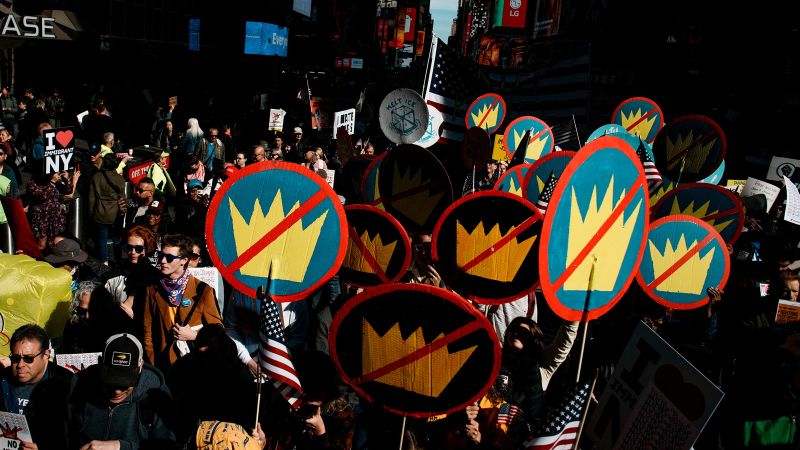
America is on the precipice of an unprecedented wave of dissent as millions prepare to flood streets nationwide this Saturday, unleashing a potent mix of anger against President Donald Trump’s controversial policies, a flagging economy, and the looming shadow of war with Iran.
Organizers confirm over 3,100 “No Kings” demonstrations – roughly one event for every county in the U.S. – are slated across all fifty states, from bustling urban centers to an Alaskan city inside the Arctic Circle. This monumental outpouring of frustration signals a powerful, suburban-fueled groundswell poised to reshape the political landscape.
America's Fury Unleashed: Why "No Kings" is Bigger Than Ever
"The people of America are pissed," declared Sarah Parker, a national coordinator with grassroots movement 50501 and a key organizer for the No Kings Coalition. "They are the ones powering this movement." This sentiment echoes louder than ever as the movement projects nearly 7 million participants, following thousands of "No Kings" events last fall that presaged the intensifying clashes over immigration enforcement.
From Immigration Crackdowns to Economic Strain: The Driving Forces
The latest surge in public outrage follows a brutal period. Trump’s nationwide immigration enforcement blitz, including operations like "Metro Surge" in Minneapolis, has left communities marred, with two Americans dead due to federal law enforcement actions. Simultaneously, Americans grapple with skyrocketing gas prices and a flagging economy, direct consequences of the ongoing war with Iran. This cocktail of grievances has ignited a firestorm of protest.
Significantly, statistics show two-thirds of this weekend’s RSVP'd participants live outside major urban centers, marking a nearly 40 percent increase from the first “No Kings” event in June 2025. This shift highlights a critical awakening in suburban communities, where rising educational levels and increasing racial diversity are shifting the political axis.
As Allison Posner, a 42-year-old mother from Maplewood, New Jersey, powerfully told The Associated Press, "I’m seeing people from the PTA or the neighborhood who would have never joined a protest in the past, who are now asking how they can get involved. This is not some other people’s fight. This is our fight."
"Red States" and Battlegrounds Join the Uprising
This weekend’s "No Kings" movement isn’t confined to liberal bastions. Organizers reveal a significant number of protests are planned in GOP stronghold states like Texas and Florida. "Almost 50% of No Kings events are in either a red state or a battleground area for this year," noted Eunic Epstein-Ortiz of the No Kings Coalition.
The numbers speak volumes: Texas, Florida, and Ohio each boast over 100 events, while Idaho, Wyoming, and Utah will see double-digit demonstrations. "We’re seeing huge RSVP surges in highly competitive bellwether suburban areas," stated Leah Greenberg, co-executive director of the Indivisible Project. "Voters who decide elections, the people who do the door knocking and the voter registration and all of the work of turning protest into power, they are taking to the streets right now and they are furious."
Minnesota: The Star-Studded Epicenter of Defiance
The flagship "No Kings" protest will unfold at the Minnesota State Capitol in St. Paul, expecting a massive turnout of at least 100,000 people. This location holds particular significance; Minneapolis and St. Paul were the epicenter of Operation Metro Surge, the largest immigration enforcement operation in U.S. history, which tragically led to the fatal shootings of Renee Good and Alex Pretti by federal agents.
After weeks of intense protests last winter, marked by federal agents using pepper balls and tear gas against demonstrators, Minnesota is ready to make its voice heard again. But this time, the tone is different – hopeful, even celebratory, despite the underlying anger. Music legend Bruce Springsteen is slated to perform, alongside a constellation of cultural icons and political leaders.
The lineup includes famed folk singer Joan Baez, award-winning actress Jane Fonda, singer Maggie Rogers, Independent Sen. Bernie Sanders, Minnesota Lt. Governor Peggy Flanagan, and Minnesota Attorney General Keith Ellison. Springsteen, known as "The Boss," told the Minnesota Star-Tribune he would perform his powerful anti-ICE anthem, "Streets of Minneapolis," a song dedicated to the city’s residents, including Pretti and Good.
Organizers, remembering the thousands who braved -10° weather to protest ICE in January, quipped, "Minnesotans have already shown we’ll stand up for democracy in -10° weather, so Saturday should be a breeze! Expect a beautiful spring afternoon and don’t forget the SPF!"
Peaceful Resistance: The Antidote to Repression
Despite the immense frustration, a core principle behind all "No Kings" events remains "a commitment to nonviolent action." Participants are urged to attend without weapons, act lawfully, and de-escalate any potential confrontation. "Peaceful resistance is the antidote to repression. And it’s the antidote to the despair and powerlessness that repression is trying to make us feel," affirmed ACLU Chief Political and Advocacy Officer Deirdre Schifeling.
This commitment builds on the legacy of previous "No Kings" rallies. While the first wave last June saw some clashes, particularly in Los Angeles, and coincided with President Trump’s 79th birthday and a military parade, the second round in October was largely peaceful. These earlier protests highlighted key themes: perceived threats to democracy, ICE raids, troop deployments in US cities, and cuts to federal programs, especially healthcare. This Saturday, the movement promises to be the most unified and impactful yet.
Key Takeaways from the "No Kings" National Rally
| Key Point | Detail |
|---|---|
| Scale of Protest | Over 3,100 "No Kings" demonstrations expected across all 50 states, with an anticipated 7 million participants. |
| Driving Grievances | President Trump's policies, immigration enforcement crackdown, two Americans dead, skyrocketing cost of living, war against Iran. |
| Suburban Groundswell | Two-thirds of RSVPs from outside major urban centers; rising diversity and education shifting political alignment. |
| Geographic Spread | Significant presence in "red states" and battleground areas, including Texas, Florida, and Ohio with 100+ events each. |
| Flagship Event (Minnesota) | Minnesota State Capitol in St. Paul, expecting 100,000+ people. Features Bruce Springsteen, Joan Baez, Jane Fonda, Bernie Sanders. |
| Core Principle | Commitment to nonviolent action; participants urged to act lawfully and de-escalate confrontations. |
Frequently Asked Questions About the "No Kings" Rally
- What is the "No Kings" movement?
- The "No Kings" movement is a grassroots coalition organizing national protests against President Trump's policies, the rising cost of living, and the war with Iran. It has seen massive growth and participation across the U.S.
- Why are people protesting this Saturday?
- Demonstrators are fueled by anger over a range of issues including the Trump administration's immigration enforcement tactics (which led to deaths), the economic strain from rising gas prices, and the perceived threats to democracy and social welfare programs.
- Where are these protests taking place?
- Over 3,100 "No Kings" events are scheduled in all fifty states, including major cities, suburban areas, and even "red states" like Texas and Florida. The flagship event is at the Minnesota State Capitol in St. Paul.
- Who are some of the notable figures involved?
- The St. Paul rally will feature performances by Bruce Springsteen, Joan Baez, and Maggie Rogers, along with speeches from Jane Fonda, Senator Bernie Sanders, Minnesota Lt. Governor Peggy Flanagan, and Minnesota Attorney General Keith Ellison.
- Are the "No Kings" protests peaceful?
- Organizers emphasize a strong commitment to nonviolent action, urging participants to avoid weapons and act lawfully. While past rallies have had isolated incidents, the movement's core principle is peaceful resistance.
