Brace for impact: A seismic shift in international trade relations just sent shockwaves through global markets. The European Parliament has slammed the brakes on a critical trade deal with the United States, citing unprecedented uncertainty after the U.S. Supreme Court dramatically dismantled most of President Donald Trump's controversial tariffs. This isn't just a hiccup; it's a full-blown crisis with profound implications for American businesses and consumers alike.
EU Pulls the Plug: Why the Deal is on Ice
In an emergency meeting in Brussels, European lawmakers declared the U.S. side of the proposed agreement "so uncertain." Bernd Lange, the parliament's influential trade committee chief, minced no words: "Nobody knows what will happen... and it's unclear if there will be additional measures or how the United States will really guarantee" its commitments. Essentially, they've lost faith in the stability of U.S. trade policy after the Supreme Court's ruling.
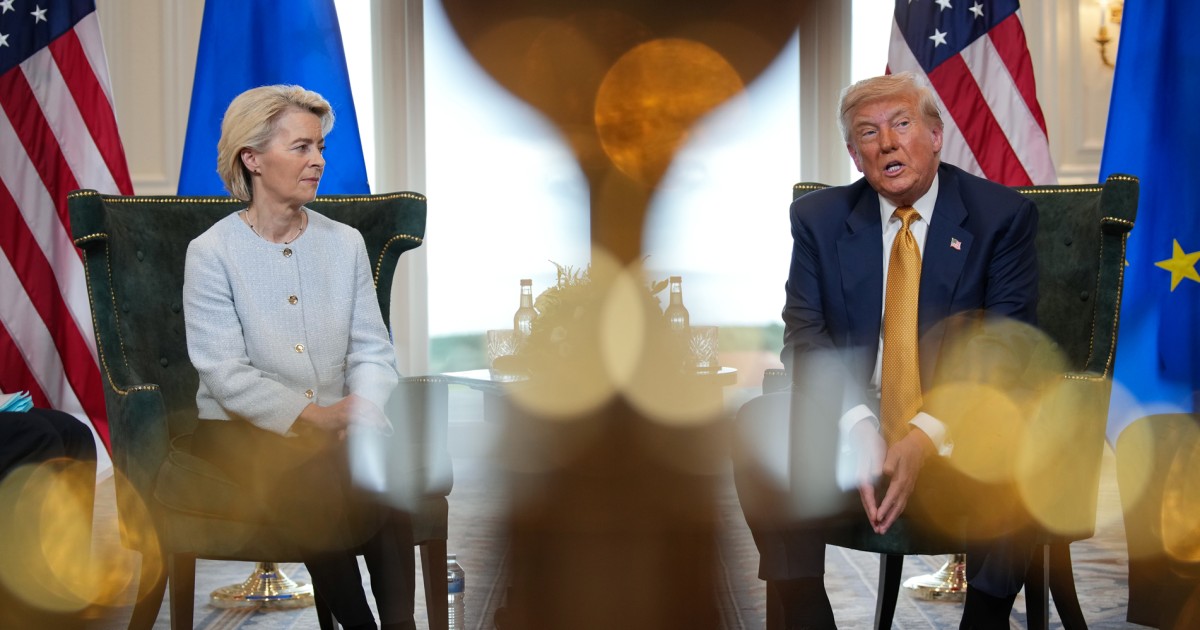
This decision throws a massive wrench into a deal hailed just last July as a "generational modernization of the transatlantic alliance." The agreement, negotiated between Trump and European Commission President Ursula von der Leyen, was designed to slash tariffs on everything from aircraft parts and generic drugs to critical raw materials, providing "certainty in uncertain times" for businesses on both continents. Now, that certainty is shattered.
Trump's Fiery Retaliation: New Tariffs Loom?
As Europe announced its halt, President Trump took to social media, unleashing a furious threat against "any country that wants to 'play games' with the ridiculous supreme court decision." His chilling promise? Countries could be hit "with a much higher tariff."
Adding fuel to the fire, hours after the Supreme Court decision, Trump signed an executive order implementing a 10% "global tariff" under a different law. By Saturday, he declared he was raising that rate to 15%, signaling an aggressive posture despite the court's actions. This move confirms that the administration is ready to bypass judicial roadblocks to continue its protectionist agenda.
Markets in Meltdown: Billions Wiped Out
The combination of European uncertainty and Trump's new tariff threats immediately triggered a massive sell-off in U.S. stocks. The Dow Jones Industrial Average plummeted over 820 points, a staggering 1.66% drop. The S&P 500 and Nasdaq Composite also saw significant declines, falling 1.04% and 1.13% respectively. Even the Russell 2000, representing smaller U.S. companies, slid 1.63%.
The financial pain wasn't limited to America. The pan-European Stoxx 600 index fell 0.4%, with benchmark indexes across the U.K., France, Germany, and other key nations ending the day in the red. Investors are clearly panicking over the prospect of a renewed global trade war.
A Rocky Road: Past Tensions and Lingering Distrust
This isn't the first time the transatlantic trade relationship has hit a snag. The deal has been "stumbling" since last summer, with the EU struggling to implement its side. Last year, the U.S. even expanded its metals tariff to hundreds of additional products, further souring relations.
Recall the mid-January crisis when Trump threatened tariffs on eight European countries if he didn't gain control of Greenland. That incident alone caused the European Parliament to pause ratification for the first time. Though Trump eventually backed down, the message from Bernd Lange was clear: "By threatening the territorial integrity and sovereignty of an E.U. member state and by using tariffs as a coercive instrument, the U.S. is undermining the stability and predictability of E.U.-U.S. trade relations."
Despite assurances, European lawmakers remained deeply skeptical. Olof Gill, an EU trade spokesman, publicly stated that the U.S. needed to provide "precisely what is going on," adding that answers from the Trump administration had been unsatisfactory.
Global Ripple Effect: India and China React
The fallout is extending far beyond Washington and Brussels. Overnight, China announced it was reviewing the U.S. Supreme Court's ruling and called for America to abandon all its tariffs. Meanwhile, trade negotiators from India have reportedly canceled a planned trip to Washington for talks on their own pending trade deal. The global trade landscape is bracing for a tumultuous period.
Key Takeaways from the Trade Tangle:
| Key Point | Impact / Detail |
|---|---|
| EU Halts Deal | European Parliament halts ratification of major U.S. trade deal due to "uncertainty" after Supreme Court ruling. |
| Trump's New Tariffs | President Trump threatens "much higher tariffs" for countries "playing games" and implements a 15% "global tariff." |
| Market Crash | U.S. stocks plummet (Dow down 820+ points), European markets also close in the red, signaling investor panic. |
| Global Reaction | China reviews ruling and calls for tariff abandonment; India cancels U.S. trade talks. |
| Past Precedent | Deal previously paused over Trump's Greenland tariff threats, highlighting long-standing distrust. |
Frequently Asked Questions (FAQ):
Q: Why did the Supreme Court strike down Trump's tariffs?
A: The source text indicates the Supreme Court struck down "most of President Donald Trump's tariffs," leading to the current uncertainty. It doesn't detail the specific legal reasoning, but the effect was a major disruption to existing trade policy.
Q: What was in the U.S.-EU trade deal?
A: The deal aimed to eliminate "trade barriers" and cap most U.S. tariffs on EU imports at 15%, with 0% tariffs on goods like aircraft parts, generic drugs, semiconductor equipment, some farm products, and critical raw materials.
Q: How will this affect American consumers?
A: Increased tariffs often lead to higher prices for imported goods. The uncertainty and potential for a wider trade war could also impact job markets and the overall economy, potentially raising costs for a range of products.
Q: Is this a permanent halt to the trade deal?
A: The European Parliament has halted the ratification process due to current uncertainty. It's not necessarily permanent, but resuming it would require significant clarification and guarantees from the U.S. side, which are currently lacking.
